Ship of Theseus: Roper Technologies

Benji Rosenblatt
There’s an old puzzle attributed to Plutarch. As the story goes, the Athenians preserved the Ship of Theseus in their harbor as a kind of memorial. Over decades, the planks of the ship rotted, and they were replaced one at a time. Eventually, not a single original plank remained, which led Plutarch to ask the question that has occupied philosophers for nearly 2,000 years: is it still the same ship?
I raise it because few companies answer that question as literally as the second subject of the Reindustrialist series, Roper Technologies (NASDAQ: ROP). Roper began in the 1800s as a maker of gas stoves, and over the following 150 years, it replaced every plank it was built from, compounding into a ~$35bn acquirer of niche, market-leading software and technology businesses.
The Photographic Negative
Like United Rentals, Roper Technologies has never captured the public imagination the way today’s darlings SpaceX, Anthropic, and OpenAI have. What it produced instead, over a seventeen-year transformation that began in 2001 under a single CEO, was a 15x+ total return that outpaced the market by more than 5x.
A few of the lessons from URI carry over to Roper: the value of discipline, of getting the major trends right, and of dialing in incentives. But how the two companies actually delivered those returns could not be more different, and that is what makes Roper worth studying.
United Rentals runs a capital-intensive business model: a multibillion-dollar fleet on the balance sheet, billions more in fleet capex every year just to stay in place, a sprawling physical branch footprint, tens of thousands of employees, and revenue that lives and dies with the construction and industrial capex cycle. Roper is almost the photographic negative: $7.9bn of revenue running on essentially no physical assets, nearly 80% of it software, more than half of that recurring subscriptions, negative working capital funded by customers who prepay, and a customer base whose spending has little to do with where we sit in the industrial cycle. URI is a true rollup, one industry, one operating system, consistent offerings across 1,500 branches, while Roper is a serial acquirer of unrelated businesses, each left to run on its own, structurally closer to Berkshire Hathaway than to United Rentals.
What is Roper
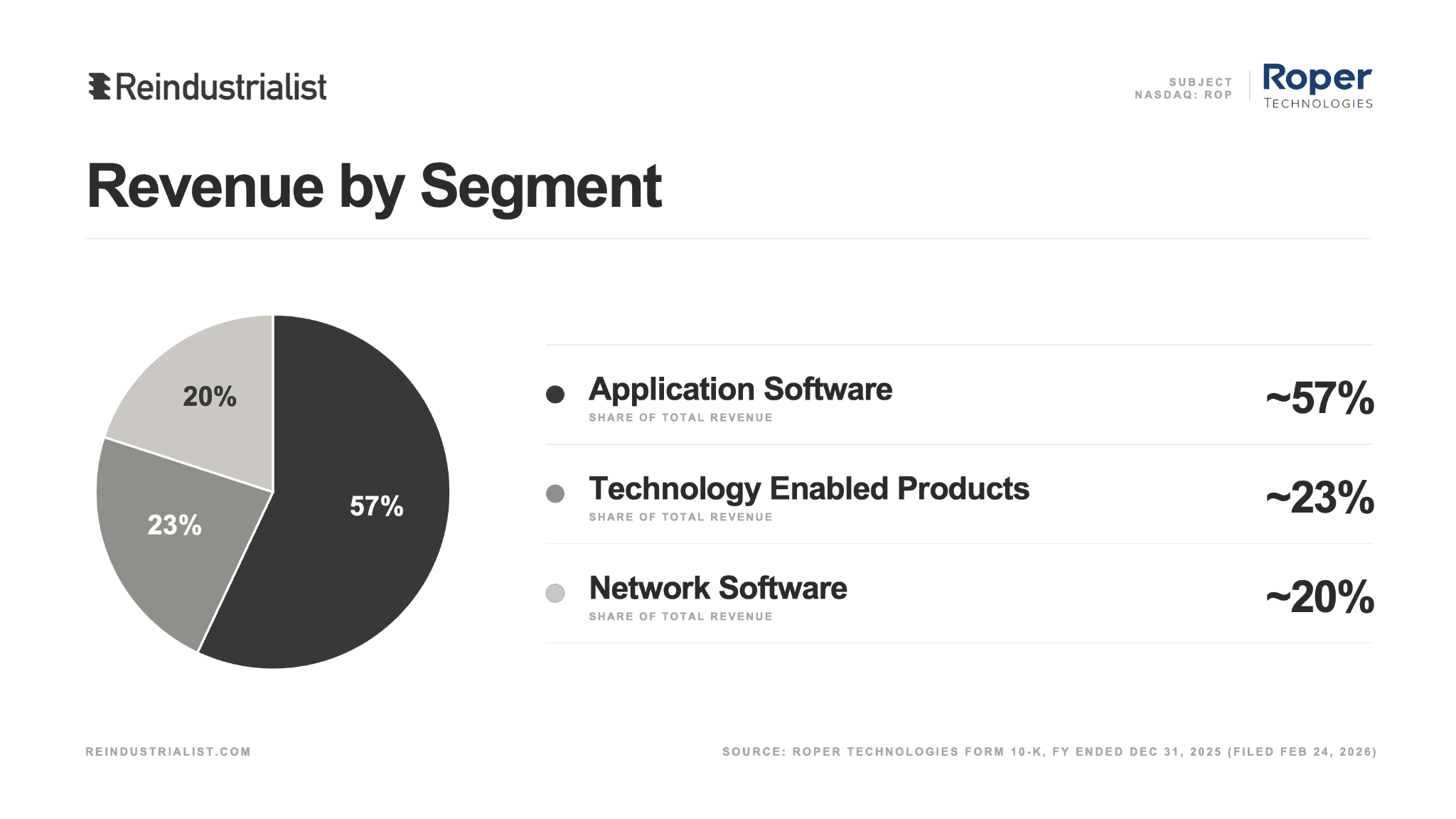
Roper describes itself simply: it “compounds cash flow by acquiring and growing niche, market-leading technology businesses.” What sits under that one sentence is considerably less simple, roughly 30 diversified businesses across three reportable segments:
Application Software (~57% of revenue): vertical-specific enterprise SaaS that runs the core back office of a profession or industry (billing, ERP, compliance, project management), the systems a customer cannot operate without. Its two largest businesses are Deltek, the default ERP for federal contractors and project-based architecture and engineering firms, and Vertafore, which sits inside more than 20,000 independent property and casualty insurance agencies across the US.
Network Software (~20% of revenue): two- and multi-sided networks whose moat is liquidity rather than lock-in, since everyone worth transacting with is already on the network. DAT Freight & Analytics runs the freight load board where brokers post freight, and carriers go to find it; iPipeline wires together the life insurance carriers, distributors, and advisors as they transact.
Technology Enabled Products (~23% of revenue): the non-software remainder. These are physical devices, but certifications, consumables, and long replacement cycles wrap them in the recurring economics of software. Here, the anchors are Neptune, whose water meters and metering infrastructure serve more than 4,000 utilities across North America, and Verathon, the point-of-care device maker behind the BladderScan and the GlideScope.
Roper’s pitch to sellers is to be the “permanent home” for scaled, noncyclical, mission-critical market leaders -- usually the number one or number two player in their niche. Because it buys with permanent capital and never has to sell, Roper carries a lower cost of capital than the PE sponsors bidding against it, and offers a deliberately hands-off operating model that leaves acquired businesses with their existing management, brand, and culture intact. The result is a flywheel: acquire a market leader at a price that pencils on cash returns, leave it alone to grow, and redeploy the free cash flow into the next acquisition. In 2025, that flywheel produced $7.9bn in revenue (+12% YoY), ~70% gross margins, ~40% adjusted EBITDA margins, and ~31% free cash flow margins.
Origins
Almost no company lasts more than a century without collecting a few good stories, and Roper had them from the start. Its founder, George D. Roper, lost his left arm as a child in a train accident. In 1857 he bought a half interest in the Van Wie Gas Stove Company in Springfield, Illinois, and nearly forty years later, in 1894, he took sole ownership only for the factory to burn to the ground ten days later. He rebuilt in Rockford under a new name, the Eclipse Gas Stove Company, and grew the business by acquisition. In 1906, he picked up a small water-pump maker called the Trahern Pump Company. With that single deal, pumps entered the Roper lineage as a rounding error next to the stove business.
In 1925, Mabon P. Roper inherited the Company and leaned hard into pumps for petroleum, an industry that would soon reorganize the entire American economy. By the Great Depression, Roper was, in its own telling, “the first and leading manufacturer of pumps for the booming petroleum industry.” During World War II, the Rockford plant converted like the rest of American industry, supplying diesel-engine lubricating pumps for Navy vessels and turning a factory built for gas ranges toward projectiles and ammunition boxes. Mabon died in 1942, ending the Roper family’s operational involvement.
Fifteen years later, in 1957, the Company sold off the entire stove business, George D. Roper’s original line. What remained was the pump operation, which moved to Commerce, Georgia, and was renamed Roper Pump Company, which later became Roper Industries. The thing called “Roper” was no longer a stove maker that happened to make pumps; it was a Georgia pump maker that no longer made stoves. (If you’ve seen a “Roper”-branded gas range in an American kitchen, that’s the legacy of this 1957 sale -- same name, different ship.)
In 1981, Roper Industries, by then a small, obscure, publicly-traded pump company, was taken private in a leveraged buyout. The new owners brought in fresh management, most consequentially a British-born A.T. Kearney consultant named Derrick Key, who joined in 1982 and became CEO a decade later. Over the next twenty years, Key turned Roper from a Georgia pump company into a three-segment industrial conglomerate, adding Industrial Controls and Analytical Instrumentation on top of the legacy pumps, and took the Company public again in February 1992. By the time Key stepped down in 2001, Roper Industries was doing nearly $600mm in annual revenue with about 3,000 employees: a well-run if unremarkable mid-cap industrial, on the cusp of becoming something else entirely.
Jellison’s Arithmetic
As mentioned in the first of the Reindustrialist series, at Third Prime, we embrace rigorous underwriting methodologies that are a bit unusual for the stages in which we invest. Building models for pre-seed companies can seem like overkill and might invite the interpretation that we let quantitative rigor supersede qualitative judgment. The opposite is true. We believe management teams are the most critical factor in any investment, and we hold every company we evaluate to that bar. Few companies illustrate that better than Roper, and few executives better than Brian Jellison, who sat at the helm for nearly two decades.
Brian Jellison learned to work before most kids learn to drive. He grew up on a six-day work week at his father’s hardware store, expected to clock a full shift the moment the school bell rang. Like George Roper a century before him, Jellison was shaped early by loss. Both his parents were gone by the time he turned eighteen. He turned that resilience into momentum: his career began in GE’s vaunted management training program, among the most coveted early-career posts in American industry at the time. But he made his name over a quarter century at Ingersoll-Rand, the diversified industrial manufacturer, where he rose on the strength of his financial acumen, despite a reputation for being gruff and blunt, to Executive Vice President and stood as a serious contender for the top job.
Despite success in climbing the corporate ladder, Jellison grew restless inside Ingersoll-Rand’s bureaucracy, which by then defined most of the industrial world. That restlessness drove him to Roper, a company roughly an eighth the size of the division he had been running, with a prestige gap even wider than the size gap.
When Jellison arrived, Roper was generating roughly $600mm in revenue at attractive margins, but its largest end market was oil and gas, roughly a third of sales, and its single biggest customer was Gazprom, whose order swings had burned the Company badly in the late 1990s. He believed that cyclicality could kill Roper, and that survival meant building revenue that did not rise and fall with oil. The only way to get there on any reasonable timeline was transformative M&A of a scale the Company had never attempted; two decades of deals under his predecessor had all been small bolt-ons.
According to Scott Davis, the famed industrials analyst who now runs Melius Research, Jellison had three core requirements for potential targets:
Reduce asset intensity
Niche industry focus
Excellent management
While the market chased the razor-and-blade model, selling large capital equipment at low margins in the hope of capturing spare parts and service fees down the line, Jellison was drawn to the simpler businesses the big players overlooked, the kind with lower cash needs and higher margins.
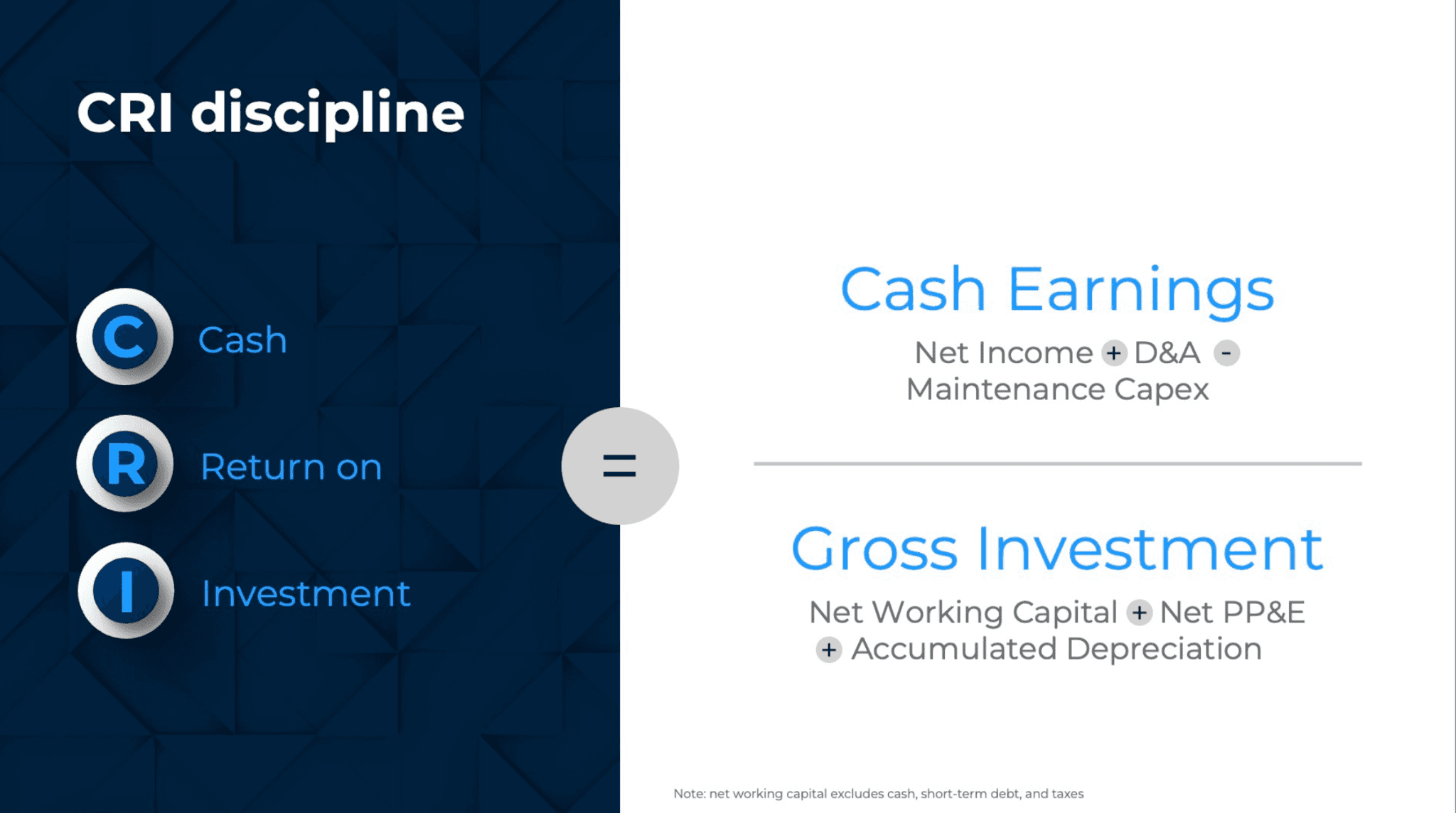
His preference rested on a structural insight about how businesses behave as they scale. A capital-heavy manufacturer has to keep feeding the machine: more plant, more inventory, more working capital, just to grow, and each of those dollars erodes the return on what is already invested. Businesses with little physical capital and high margins work the opposite way, because growth demands almost no new investment; every additional dollar of revenue converts to cash and lifts the return on the slim asset base beneath it. Jellison named this measure cash return on investment, or CRI.
The market, he had found, paid up for exactly this: the higher a business’s return on its asset base, the richer the multiple it tended to command. A high-CRI business rewarded him twice, once in the cash it threw off and again in the multiple the market was willing to assign it.
Proof of Concept
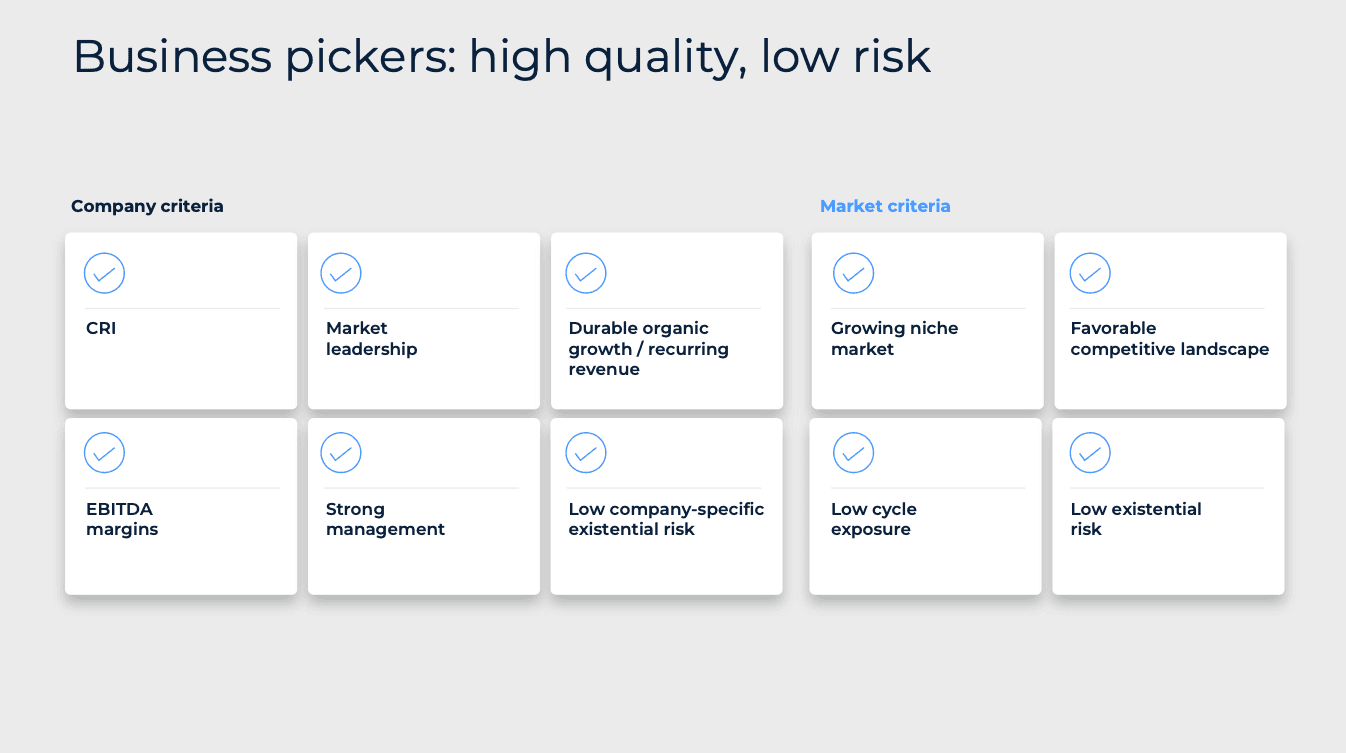
As an investor, I know the easy part is writing down a buy-box; the hard part is finding deals that actually fit it, and doing it again without drifting. Roper’s criteria, shown below, are almost impossible to argue with. Who wouldn’t want a business that throws off high cash returns on the capital invested, leads its market, earns rich EBITDA margins, and grows organically on recurring revenue? Who would turn down a growing niche, a favorable competitive landscape, strong management, and little exposure to the economic cycle? The list reads less like a strategy than a definition of a good business. What is rare is not the criteria, which almost anyone would sign up for, but the discipline Roper built to find the businesses that genuinely clear every bar, and to keep passing on the thousands that don’t, year after year, for decades.
In December 2003, roughly two years into his tenure, Jellison made his first real bet on that framework: approximately $475mm for Neptune Technology Group, a maker of water meters and meter-reading systems for municipal water utilities. The deal mattered as much for what it signaled as for what it was. Roper had grown up doing bolt-ons; Neptune was a platform, and an unglamorous one. To a market that still priced Roper as an industrial-instrumentation play, an Alabama water-meter maker looked like a strange place to spend real money.
The genius of Neptune is in the cadence of its cash flow. A city has no choice about metering and billing for water, in a recession exactly as in a boom, which strips demand of any link to the industrial cycle. The meters themselves wear out on a predictable, decade-plus schedule, so replacement revenue arrives like clockwork from a captive base of utilities that almost never switch vendors. On top of that hardware annuity, Roper could layer automated meter reading, and later advanced metering infrastructure, adding software-like recurring revenue that grew without much new capital behind it. Noncyclical, replacement-driven, mission-critical, asset-light: Neptune was the first full-scale proof that the CRI math existed out in the world, and that Jellison could go buy it.
If Neptune proved the math existed, TransCore proved it was not a quirk of one industry. In December 2004, barely a year later, Roper paid roughly $600mm for the maker of RFID readers and electronic toll-collection systems that sits behind much of the tolling Americans drive through every day, from Oklahoma’s PikePass, the first statewide electronic toll system in the country, to the tags on Texas windshields. If you have ever passed under a gantry in the Sun Belt without touching the brakes, you have used TransCore’s technology.
What made TransCore a different kind of prize was where its recurring revenue came from. Neptune’s cash arrived when hardware wore out and got replaced; TransCore’s arrived through the long-term contracts under which it operated and maintained the toll systems it had built, processed the transactions flowing through them, and kept selling transponder tags into a growing base of drivers, recurring work that made up nearly 60% of revenue at the time of the deal. The customers were governments locked into multi-decade systems whose hardware was not merely sticky but bolted to the road. Traffic softens in a recession, but it does not collapse the way drilling activity does. Same destination as Neptune, reached through an entirely different engine: one business compounds on the replacement clock, the other on service contracts that run as long as the roads they sit on. Jellison was not buying one template over and over. He was collecting different expressions of a single idea, which is why CRI kept turning up deals long after a narrower rule would have run dry.
In under three years he had converted a meaningful slug of Roper’s cyclical, capital-hungry revenue into recurring, mission-critical, asset-light cash flow, and shown the trick was repeatable across industries that had nothing to do with one another. Over the next fifteen years Roper ran versions of this dozens of times, and with each turn the portfolio’s center of gravity slid further from hardware toward pure software.
Actions over Names
In venture, you learn to separate those who talk about it from the ones who are about it. Plenty of companies today like to call themselves AI-native when all they have really done is keep pace with the latest model releases, while the rare few who actually are tend to overhaul how they operate without saying much at all.
More than a decade of deliberate change had pulled the company away from cyclical industrial manufacturing and toward technology and recurring software. Roper marked the shift in the most understated way imaginable, changing a single word to become Roper Technologies. The rename did not so much launch the transformation as acknowledge one that the portfolio had already made real.
Living up to that name demanded a kind of mental flexibility that is far rarer in practice than it sounds, because it required Roper to become a willing seller of good businesses. Most management teams are constitutionally buyers, since acquisitions feel like progress and make the company bigger, while divestitures can feel like retreat or like a quiet admission that owning the business in the first place had been a mistake. Yet buying is only half of capital allocation. The willingness to sell is the other half, the one most companies neglect (S&P 500 companies acquire at more than four times the rate they divest). The businesses Roper parted with were not broken or failing. They were profitable and long-held, and the pump business was the very operation the Company had been born from. Selling it meant prying loose the last original plank and asking only the question that actually mattered: whether the capital tied up in the business still earned its place or could compound faster elsewhere.
The decisive break came in 2022, when Roper sold a majority stake in its entire industrial and process-technology portfolio to the private equity firm Clayton, Dubilier & Rice, in a transaction that valued those businesses at roughly $3.7bn and handed Roper about $2.6bn in upfront cash. The carved-out operations, which included the legacy pumps and the compressor and process-control businesses whose lineage ran all the way back to the Trahern pump George Roper acquired in 1906, were combined into a new standalone company called Indicor. In a single stroke, Roper parted with the last of its original planks and kept only a minority interest in the ship it used to be.
TransCore made the same journey in miniature, and its arc reveals as much about Roper’s discipline as any acquisition ever did. The tolling business Jellison had bought in 2004 as a model of the recurring, mission-critical cash flows he was chasing was itself sold in 2022, to ST Engineering for roughly $2.7bn, once its project-heavy mix of hardware, installation work, and government contracting no longer fit the software-centered standard Roper had set for itself. TransCore was not failing, and the sale, at more than four times what Roper had paid, was no admission of error; the business simply belonged to a chapter the Company had decided to close.
Built to Run Without Him
Jellison had spent the early part of his career inside corporate bureaucracy, and he built Roper’s operating model to be everything that bureaucracy was not. He stripped out the layers of overhead he had come to see as a tax on a good business, and pushed authority down to the people who actually ran the niches.
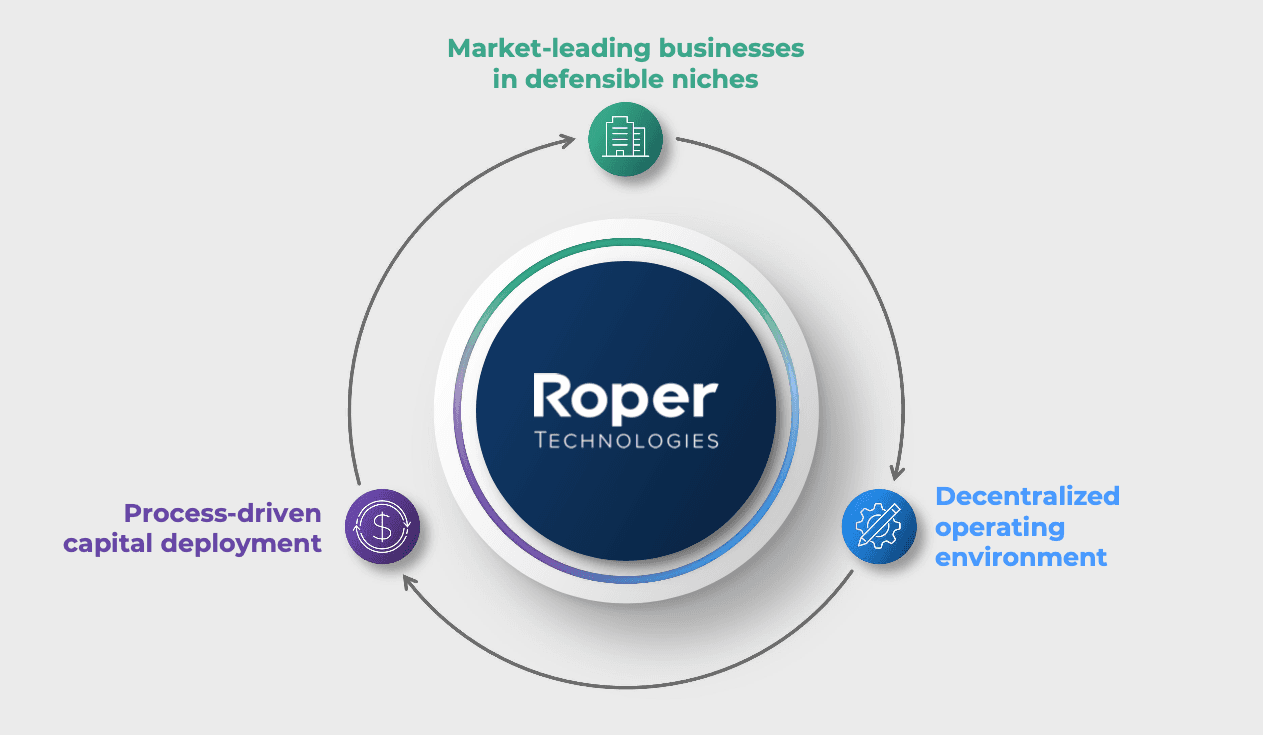
Roper runs as the opposite of the integrated conglomerate. Each business keeps its own management, brand, and P&L and is left almost entirely alone, while a deliberately tiny corporate center (~50 employees) allocates billions in capital, sets incentives, and otherwise stays out of the way. There are no forced synergies and no integration playbook, because the whole premise is that Roper only buys excellent businesses.
Roper pays its leaders on year-over-year growth in cash flow rather than against a negotiated budget, because executives will lowball any target they are allowed to negotiate. The rule is simply to beat last year, with no forgiveness for a soft market or a down cycle. In return, the payout works something like an asset manager’s “2 and 20”: clear the baseline and earn a thin slice, but capture a far larger share of everything above it. It turns each leader into something close to an owner, which is exactly the mindset the culture is built to select for.
Jellison’s run ended abruptly. As his health failed in 2018, he stepped down as CEO, handed the role to Neil Hunn, his Chief Operating Officer, and stayed on as Executive Chairman, only to pass away a few months later. On the first earnings call after he stepped down, management was careful to reassure investors that Roper would keep executing the strategy Jellison had architected, but what came through most clearly was the respect in the analysts’ voices, an unmistakable appreciation for the magnitude of what he had pulled off in taking a sleepy industrial pump company and turning it into one of the best-performing compounders of his era.
The Multiple, Not the Machine
As of mid-2026, the market has fallen out of love with Roper. From an all-time high near $595 in early 2025, the stock has shed more than 40% to the mid $300s, one of the sharpest drawdowns in its modern history. The reflex is to assume something broke, yet almost nothing did: revenue still compounded at double digits, free cash flow margins held near a third of sales, and the portfolio kept throwing off cash exactly as designed. What contracted was the multiple, not the machine, and part of that was never about Roper specifically. As the Company remade itself into a vertical-market software business, it came to trade like one, and when the software complex re-rated, Roper re-rated down with it. Sitting on top of that was a company-specific premium: Roper had spent years priced for perfection at roughly 30x forward earnings, and a stock that rich does not need a disaster to fall, it only needs to stop being flawless.
And it did stop being flawless, in one specific way worth taking seriously. Organic growth, the engine that is supposed to keep compounding between acquisitions, slowed to the mid-single digits, with Hunn calling back-to-back 4% quarters “unsatisfying.” A serial acquirer that has to keep buying growth is more fragile than one whose existing businesses still grow on their own. But it is a very different problem from the one the share price implies, and the distinction between a compounder that has de-rated and a compounder that has deteriorated is the key question for anyone looking at Roper today.
A lower share price barely touches how Roper actually makes money. It buys with cash flow, not stock, so a market that has repriced everything down mostly lowers the cost of its next acquisition rather than raising its own cost of capital. The firms it competes with for those deals are mostly private equity, and they are now sitting on aging portfolios while their investors push them to return capital, which turns them into sellers right when Roper wants to buy. Very few buyers can credibly offer a scaled, mission-critical business a permanent home instead of another five-year flip, and Roper is one of them.
Relevance to Venture
Pivoting is not a four-letter word. Here’s where I part with a lot of my peers: I like pivots. Plenty of investors treat a pivot as a tell that the founder got the first answer wrong and will probably get the next one wrong too, and they pass on principle. I think that’s a mistake, and Roper is the most expensive counterexample I know of. It started out selling gas stoves, became a pump maker, became an oil-and-gas instrumentation business, and today compounds as a vertical software company. Far from resisting change, Roper changed everything about itself except the one word on the door. What made it work is what it refused to change: Jellison was never attached to pumps; he was attached to the math, so when the world handed him a business that scored better against CRI, he sold the thing the Company was named after and bought the better one.
A pivot fails when you change everything, including the one thing that was supposed to stay fixed, and it works when you hold a north star steady and let everything replaceable rotate around it. If you have looked honestly at what you have built and concluded the business is compromised, that is not failure; with a clear destination, a redirect is just capital allocation. And if SaaS was to pumps what AI now is to software, plenty of companies built before AI are sitting on a pump right now.
Watch your activity bias. The hardest discipline at Roper is the one that leaves no fingerprints, because the corporate center passes on the overwhelming majority of the businesses it evaluates and leaves the ones it already owns almost entirely alone, which means that on most days, the highest-value thing it can do is nothing at all. That runs against every instinct an ambitious person has, since inactivity reads as negligence and motion reads as contribution, even in the many cases where the motion is precisely what breaks the business.
Investors carry the same bias, and a fair amount of what passes for “value-add” is theater. The line I try to hold is to speak up when I can genuinely help and stay quiet when the only thing talking would accomplish is reminding the room that I am in it.
Culture is the best moat. There is a fashionable idea right now, usually called “founder mode,” that the best leaders stay buried in every detail, override their managers, and treat delegation as a slow leak of standards. Roper demonstrates the risks of taking that instinct too far, because its entire model assumes the opposite, that you hire people who behave like owners, hand them high degrees of autonomy, measure them on one quantitative outcome rather than on how busy or how loyal they look, and then trust them enough to leave them alone. The “autonomous competitors” in Roper’s culture materials are not a slogan but a requirement: a 50-person center cannot direct thirty businesses and would not want to even if it could.
The part I think gets missed is that Roper pays its operators like owners, the same lesson URI’s incentive structure taught using a different form. Motivated owners do not need to be pushed so much as unblocked, and that is why I have come to see culture as one of the most durable advantages a company can hold. A high-trust, autonomous culture where people are paid for their contribution and otherwise trusted to do the work compounds and is hard to copy. This beats the alternative of trying to supervise performance into existence.
So is it the same ship? I’d argue yes. What stayed constant was the discipline that chose which planks to keep and which to pull, and it is still running today.
That willingness to become something else the moment the math demands it is exactly what I look for in founders. So if that is the Company you are building, or you are quietly holding a pump and already know it, I would love to hear from you.
Research Archive


Reindustrialist: Upcoming Coverage
Upcoming
Join the research distribution
© Reindustrialist 2026. All rights reserved.
The information provided is for informational purposes only and does not constitute investment advice.